
What Are the Occipital Nerves?
The occipital nerves are located toward the back of the head and provide sensation to portions of the scalp and surrounding areas.
When these nerves become irritated, patients may experience pain in the back of the head, upper neck, or scalp.
For some patients, an occipital nerve block may be considered as part of a diagnostic and treatment plan.
 What Does Occipital Nerve Pain Feel Like?
Symptoms vary, but patients may describe:
- Sharp or shooting pain
- Burning sensations
- Aching at the back of the head
- Scalp sensitivity
- Tenderness behind the ears
- Upper neck discomfort
- Pain that travels toward the top of the head
Some people may notice that touching or brushing the scalp aggravates their symptoms.
What Can Irritate the Occipital Nerves?
Potential contributors include:
- Muscle tension
- Neck problems
- Arthritis
- Injury
- Repetitive strain
- Irritation surrounding the nerves
Headaches and head pain can have many different causes, so an evaluation is important before determining whether the occipital nerves are involved.
What Is an Occipital Nerve Block?
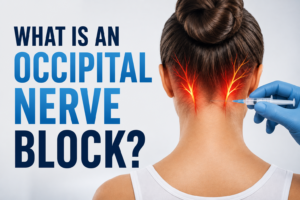
An occipital nerve block is a minimally invasive procedure in which medication is injected near an occipital nerve.
Depending on the patient’s condition and treatment plan, medication may include a local anesthetic and an anti-inflammatory medication.
The goal is to temporarily interrupt pain signaling and potentially reduce nerve irritation.
Can an Occipital Nerve Block Be Diagnostic?
Yes. Nerve blocks can sometimes provide valuable diagnostic information.
If blocking a specific nerve significantly changes the patient’s symptoms, that response can help the physician determine whether the targeted nerve is contributing to the pain.
What Happens During the Procedure?
The area is cleaned and the patient is positioned comfortably.
The physician identifies the appropriate location and carefully places the needle near the targeted nerve. Medication is then delivered.
Because the procedure does not involve a major incision, patients generally do not require the type of recovery associated with surgery.
What Happens Afterward?
Your physician will provide instructions based on your specific procedure.
Some patients may experience temporary soreness around the injection site.
The duration of symptom improvement varies from person to person.
When Should You Consider an Evaluation?
If headaches or pain around the back of your head repeatedly interfere with work, sleep, exercise, or daily activities, an evaluation may help determine the source.
At Legacy Integrative Pain, identifying the underlying pain generator is an important part of developing a personalized treatment plan.