
 What Is the SI Joint?
When people experience pain around the lower back, pelvis, or buttocks, they often assume the problem is coming directly from the lumbar spine. However, the sacroiliac (SI) joint can also be an important source of pain.
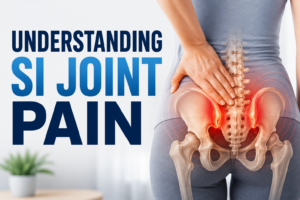
The SI joints connect the sacrum, located at the bottom of the spine, with the pelvis. These joints help transfer forces between the upper body and legs and provide stability during activities such as walking, standing, bending, and climbing stairs.
When the SI joint becomes irritated or inflamed, the resulting discomfort can sometimes feel very similar to lower back pain.
What Does SI Joint Pain Feel Like?
SI joint pain can vary from person to person.
Common symptoms may include:
- Pain in the lower back
- Pain on one side of the pelvis
- Buttock pain
- Discomfort around the hip
- Pain while standing
- Pain when walking
- Difficulty climbing stairs
- Discomfort when changing positions
- Pain after sitting for extended periods
Some patients describe the pain as aching, while others may experience sharper or more localized discomfort.
What Can Cause SI Joint Problems?
Several factors may contribute to SI joint irritation.
These can include:
- Arthritis
- Previous injury
- Repetitive stress
- Changes in walking mechanics
- Leg-length differences
- Pregnancy-related changes
- Previous spinal surgery
- Increased stress on the pelvis
The SI joint can also become irritated when the surrounding muscles and joints aren’t functioning properly.
Why Can SI Joint Pain Be Difficult to Diagnose?
One of the challenges with SI joint pain is that symptoms can overlap with other conditions.
Pain in the same general region can also originate from:
- Lumbar discs
- Facet joints
- Spinal nerves
- Hip joints
- Muscles
- Other structures surrounding the pelvis
Because of this, simply identifying the location of pain isn’t always enough.
A physician may perform a physical examination and use specific provocative tests to determine whether the SI joint may be contributing to symptoms.
What Is an SI Joint Injection?
For selected patients, an SI joint injection may be used as part of diagnosis and treatment.
During the procedure, medication is carefully delivered into the SI joint. Image guidance may be used to help accurately position the needle.
The injection may help reduce inflammation and discomfort.
It can also provide useful diagnostic information. If pain improves significantly after medication is delivered to the SI joint, this may support the conclusion that the joint is contributing to the patient’s symptoms.
What Other Treatments May Help?
Treatment depends on the underlying cause and severity of symptoms.
A comprehensive treatment plan may include:
- Physical therapy
- Stretching
- Strengthening exercises
- Activity modification
- Medication when appropriate
- SI joint injections
- Other minimally invasive procedures
The goal is not simply to reduce pain temporarily but to help patients improve function and return to activities they enjoy.
When Should You See a Pain Specialist?
Consider an evaluation if pain around the lower back, pelvis, buttocks, or hip continues despite home treatment or begins interfering with daily activities.
A proper diagnosis can help determine whether the SI joint, spine, hip, or another structure is responsible.